


) (1).png)
24 September 2026
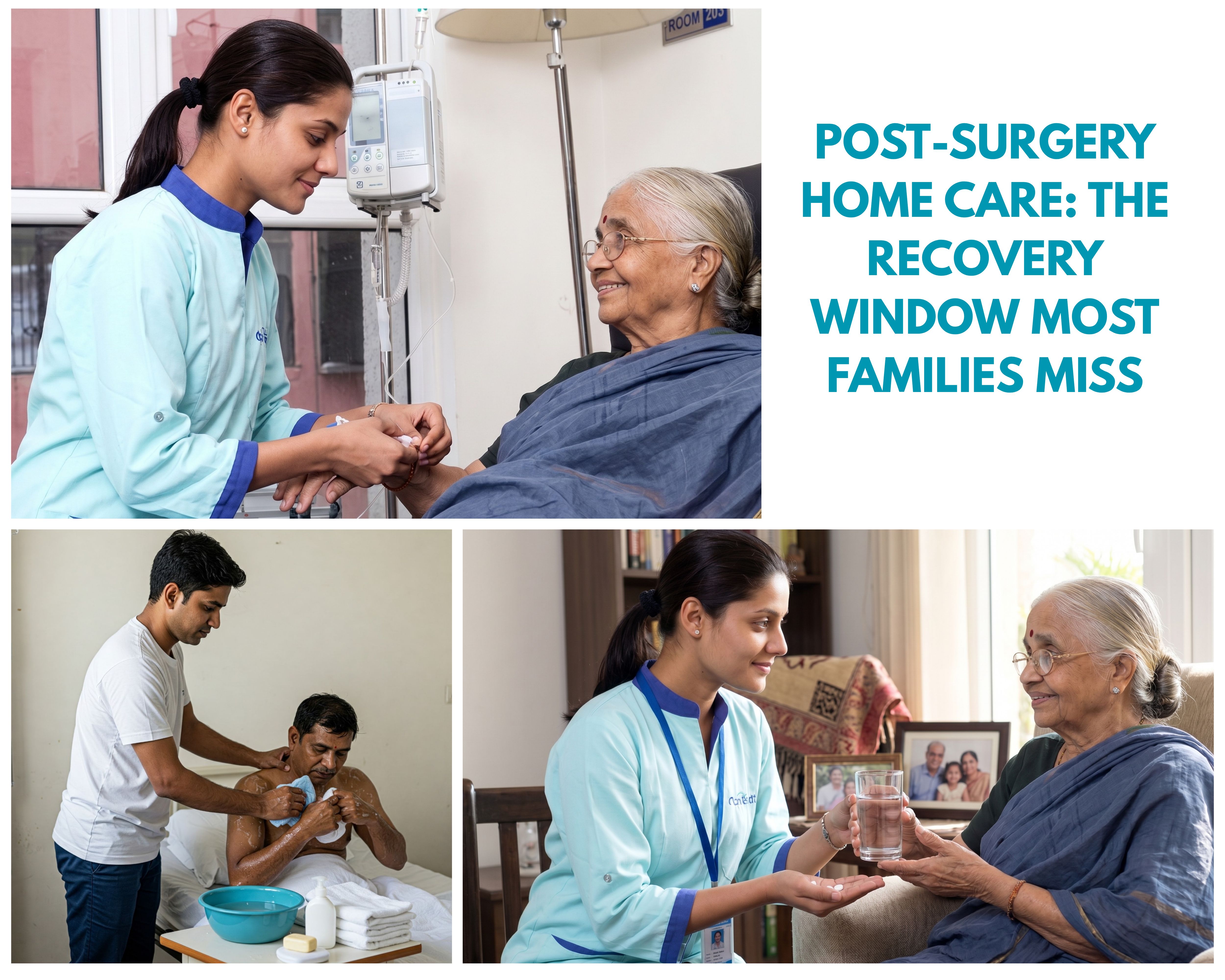
Post-Surgery Home Care: The Recovery Window Most Families Miss
Most families think the hard part ends when surgery is over.
It doesn't.
Surgery happens in a controlled environment -monitored, precise, and handled by trained professionals. Recovery happens at home -where routines slip, observation is inconsistent, and decisions are made without clinical clarity.
And this is exactly where things start going wrong.
There is a critical phase after discharge-a narrow, unpredictable recovery window-where progress can either move in the right direction or quietly start declining without obvious signs.
The problem is not lack of care. Families are present, involved, and trying their best.
The problem is overconfidence, partial understanding, and the assumption that “ghar pe rest ho jayega” (recovry will happen just by resting at home).
But recovery is not just rest.
It is active management -of symptoms, timing, movement, hygiene, and early warning signs.
And when that management is missing, small issues don't stay small.
And by the time they are noticed, they are no longer easy to control.
Why “Stable” Doesn't Mean Safe
Hospital discharge patients when they are stable -not when they are fully recovered. That distinction is where most families go wrong.
“Stable” means:
- Vital signs are under control
- Immediate surgical risk is reduced
Recovery can continue at home
It does NOT mean:
- The patient is independent
- The body has healed
- Complications are unlikely
Yet discharge is treated like a finish line.
In reality, it's the start of the most sensitive phase of recovery.
What Actually Happens at Home
Let's make this practical.
Day 1 at home feels manageable. The patient is resting. Family members are attentive. Everything seems “under control.”
By Day 3-4, reality starts to shift.
People get tired. Sleep cycles break. Work responsibilities return. Attention becomes inconsistent.
And this is where small mistakes begin.
Not out of negligence -but becaubecause no one is trained to catch them.
Real Observations from Home Recovery
These are not rare situations. These are everyday patterns:
- A mild fever is ignored - early infection goes unnoticed
- “Limited movement” becomes complete bed rest - stiffness and bed sore risk
- Medicines are delayed or irregular - pain and swelling increase
- Improper support while moving - stitch strain and delayed healing
Confusion or withdrawal - dismissed instead of monitored
None of these seem serious in the moment. That's the problem.
The impact is not immediate -but it builds quietly.
Recovery Gets Delayed
A healing process that should take 10-12 days stretches into weeks.
Small Issues Become Complications
A mild infection, swelling, or discomfort turns into something that needs medical intervention.
Hospital Visits Start Again
One missed sign leads to re-admit. More cost, more stress, more disruption.
Family Burnout
Sleep breaks, constant tension, and decision pressure affect everyone at home.
Long-Term Impact
Improper recovery can affect mobility, strength, and confidence of the patient.
This is the real cost of “we'll manage.”
What Proper Recovery Actually Requires - And Why Support Matters
Post-surgery recovery looks simple from the outside, but in reality, it demads consistent, informed execution.
It requires:
- Daily observation of temperature, pain, swelling, wound condition, and behavior
- Medication discipline with exact timing and dosage -no delays, no guesswork
- Hygiene and infection control through proper dressing and early detection
- Safe movement to avoid strain, stiffness, or injury
- Recovery-focused nutrition that actually supports healing
- Emergency awareness -knowing what can wait and what cannot
This is structured care.
And this is where most families struggle -not because they don't care, but because managing all of this consistently, day after day, is not simple.
This is exactly where a trained patient caretaker changes the outcome.
They bring:
- The ability to identify early warning signs before they escalate
- Discipline in routines that families often can't maintain
- Correct handling techniques that prevent avoidable setbacks
- Consistency -whether it's day, night, or an unexpected situation
As a result:
- Medicines are given on time, every time
- Small issues are caught early instead of becoming complications
- The patient is handled safely and confidently
- Recovery stays on track instead of getting delayed
- The family gets clarity, rest, and reduced stress
This is not about convenience.
It is about reducing avoidable mistakes during a phase where even small errors have consequences.
.png)
) (1).png)

).png)